Bounce Blast
- 3.8
- Rating
- 1.00M
- Installs
- Free
- Price
 Analysis by App-foxy
I found Bounce Blast easy to understand within seconds: tap the screen, watch jelly blocks bounce through a colorful puzzle scene, and try to create satisfying crashes. It is a casual game from VOODOO, and its appeal is immediate rather than complicated. I can pick it up for a short break without first learning a long rulebook, yet the timing of each tap gives the simple idea a little more depth than the store summary suggests.
My first impression was that this is designed for quick bursts of play. The bright presentation makes the action readable, while the bouncing blocks give every move a physical, playful feel. It does not ask me to build a large strategy over several hours. Instead, it focuses on the small satisfaction of making the next interaction work better than the last one.
That makes it a natural fit for someone who wants a lightweight casual puzzle game rather than a demanding competitive experience. It is free to start, rated Teen, and has passed the one-million-install mark, so it is clearly aimed at a broad mobile audience. Still, its simple controls should not be confused with unlimited depth. Whether it holds your attention depends heavily on how much you enjoy repeating short physics-style challenges.
You May Also Like

 Blood Strike: 2.5 Anniversary
Blood Strike’s Loadouts Turn Every Drop Into a Tactical Gamble
A close look at Blood Strike’s custom loadouts: how fast access to signature weapons reshapes its battle royale rhythm, rewards preparation, and narrows the gap between fights.

 Pandora - Music & Podcasts
Pandora’s Music Is Easy to Start, but Harder to Recover
Pandora’s strength is its low-effort path from a seed to a station. Its weak spot is how much confidence it asks you to place in connection, setup, and quiet recovery.

 8 Ball Pool
 Is Built on Rivalries, Rematches, and Routine
A close look at the rivalries, rematches, shared routines, and unanswered safety questions that turn a quick pool match into a persistent mobile community.

 Samsung Music
’s Quiet Strength Is Playing What You Already Own
Its reach comes less from spectacle than from dependable access to a personal library. That simplicity is both the app’s strongest retention engine and its ceiling.

 AccuWeather: Weather Radar
AccuWeather Review: A Quick, Clear Forecast for Everyday Decisions
For everyday plans, the best forecast is the one you can understand quickly. AccuWeather makes rain timing, radar, and local conditions easy to act on, with a few trade-offs.

 Hill Climb Racing
Why Hill Climb Racing Still Turns Crashes Into One More Run
A tiny car, a bumpy hill and one more upgrade: Hill Climb Racing keeps resurfacing because its simple chaos makes every near-miss feel personal.
More From Our News Desk



How Bounce Blast feels in everyday play
I find Bounce Blast easiest to enjoy when I treat it as a small pause in the day, not a game that needs a long warm-up. In this section, I’ll look at how its quick taps and bouncing blocks fit into ordinary routines, then move on to what a new player should expect before the first round.
Quick starts and realistic speed expectations
The strongest part of the experience is how quickly I can get into a round. There is no need to memorize a complicated control scheme: tapping is the main conversation between me and the game. That immediacy matters when I have only a few minutes, such as waiting for a bus, taking a short coffee break, or winding down before bed.
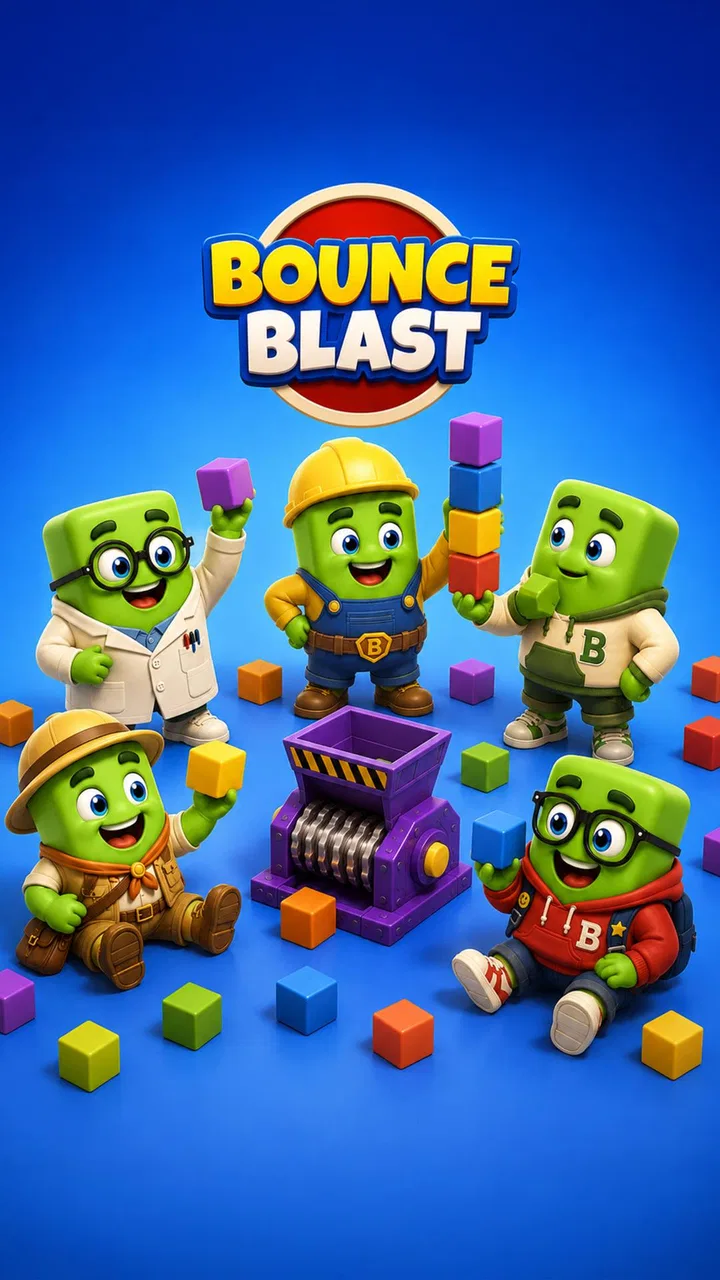
The visual idea also helps the game feel lively. Jelly blocks do not look rigid or technical, so their bouncing and crashing create a softer, more playful rhythm than a conventional tile-matching board. I found myself watching the movement as much as planning the tap. The best moments come when one action produces a chain of motion that feels larger than the input itself.
That said, I would not approach this as a game built around cinematic speed. Its attraction is responsive, bite-sized interaction, not a constant stream of high-pressure action. If you prefer games that throw new mechanics at you every few minutes, the straightforward format may begin to feel familiar. If you prefer a calm activity with a clear visual payoff, the pace is more inviting.
A useful way to judge it is to ask what kind of break you want. For a short distraction, the direct controls are an advantage. For a long session, the repeated bounce-and-crash loop needs to remain enjoyable on its own. I think it works best when I treat each play session as a collection of small attempts rather than expecting a large adventure or a deep story.
What happens during heavier use
Longer sessions change the experience more than short ones. At first, the colorful movement and immediate feedback carry the game. After repeated attempts, I pay more attention to whether each puzzle still gives me a reason to adjust my timing or rethink the next tap. That is where the game’s casual design becomes both its strength and its limitation.
The strength is accessibility. I can pause mentally, return after a distraction, and understand the basic objective again without needing to reconstruct a complicated plan. The limitation is that players looking for layered progression may find the central action too narrow over time. This is not the kind of game I would choose when I want a large map, character development, or a long-form campaign.
For heavier use, I recommend short rotations rather than treating it as an all-evening game. A few rounds during a commute or between tasks make the bouncing blocks feel fresh. Playing continuously for a long stretch may expose the repetition more quickly, especially if you normally prefer strategy games with several interacting systems.
One practical tip is to avoid tapping automatically just because the screen is active. I got more enjoyment by watching the movement for a moment and using each tap deliberately. That small change turns the game from a reflex exercise into a timing puzzle. It also helps me notice whether I am improving my decisions or simply repeating the same mistake.
Another useful habit is to separate experimentation from serious attempts. On one try, I can test what happens when I tap earlier or later without worrying about the result. On the next, I can apply what I noticed. This approach gives the simple control scheme more room to breathe and is more satisfying than treating every round as a race.
Reliability and recovering after interruptions
For a mobile game, recovery matters almost as much as the opening seconds. I often play casual titles while switching between messages, music, and other daily tasks. Bounce Blast makes the most sense in that environment when I can return to it without feeling that I have committed to a major session.
I would still keep expectations realistic. A tap-focused game is easy to reopen, but that does not automatically mean every interrupted moment will feel identical. Phone calls, app switching, and low available resources can affect any mobile experience. I prefer using it when I can give the screen my attention for a few minutes instead of starting a round while expecting to leave immediately.
The game’s compact design is helpful here because the mental recovery is simple. I do not need to remember a complex inventory, a large quest chain, or several character abilities. When I return, the core question is still clear: where and when should I tap to make the blocks move in the most useful way?
That simplicity is also why I think it suits casual players better than people who want persistent progress to dominate every session. If your ideal game lets you stop at any point and come back later without losing the feeling of control, this format is appealing. If you need detailed checkpoints, extensive planning tools, or a strong long-term narrative, another category would serve you better.
Device limits, storage expectations, and battery habits
The game supports devices running Android 8.0 or newer, which gives it a reasonably broad starting point for Android users. That does not mean every compatible phone will feel exactly the same. Screen size, available memory, background apps, and the age of the device can all influence how comfortable a colorful physics-oriented game feels during extended play.
On an older or entry-level phone, I would begin by closing demanding apps before a long session and keeping the device from becoming unusually warm. Those are sensible habits for any game with continuous animation. I would also avoid judging performance from a single moment immediately after opening several other applications, since the phone may already be under pressure.
Battery use is another reason I see this as a short-session game. Bright animation and repeated interaction can be more noticeable during a long play period than during a quick round. I would not choose it as my main activity when my battery is already low, especially if I still need the phone for navigation or communication later.
The practical trade-off is straightforward: the visual movement makes the game more enjoyable, but animated play is generally more demanding than a static word puzzle. Someone using a recent mid-range or high-end device is likely to care more about the game’s repetition than its basic demands. Someone using an older phone should test a short session first and pay attention to heat, responsiveness, and how quickly the battery drops.
There is also a comfort issue that is easy to overlook. Because the action is based on tapping and watching moving blocks, I found it better to play with the phone held steadily rather than constantly shifting it between hands. That is especially useful during travel, where an unstable grip can make a precise tap feel less precise than it really is.
Where it stands beside familiar casual alternatives
Compared with a traditional match-three game, Bounce Blast feels less focused on arranging a board and more focused on timing and physical motion. Compared with an endless runner, it is less about steering through a continuously moving environment and more about making individual interactions count. Compared with a large strategy game, it is far easier to enter but offers fewer layers to manage.
That comparison explains who should download it. I would recommend it to someone who enjoys colorful feedback, quick rules, and the pleasure of seeing a tap produce a lively result. It is also a good option for players who feel overwhelmed by games with complicated menus, long tutorials, or extensive resource systems.
I would suggest skipping it if you want a strong story, serious competition, or a deep progression structure. It may also be a poor match if you dislike games that rely on repeating a central action. The colorful jelly-block presentation is distinctive, but presentation alone cannot replace variety for a player who needs constant mechanical change.
The free entry point lowers the risk of trying it, but the presence of in-app purchases ranging from ninety-nine cents to ninety-nine dollars and ninety-nine cents per item is worth keeping in mind. I would approach those purchases carefully and decide in advance whether I am comfortable spending anything. The game is easier to evaluate when I judge the basic play first instead of assuming that optional spending is necessary for enjoyment.
Small techniques that make the loop more rewarding
The first technique I found useful is to watch the block’s movement before tapping, rather than treating every screen as an immediate command. That pause gives me a better sense of rhythm and makes successful crashes feel earned. It is a small adjustment, but it separates deliberate play from random tapping.
The second is to use the game as a focus reset. When I have finished a task and need a short mental break, one or two attempts provide a clear boundary between activities. I would not use it during a situation requiring constant attention, but it works well as a controlled interruption because the rules are easy to recall.
The third is to judge progress by decision quality, not only by whether a particular attempt succeeds. Since the game’s appeal comes from interacting with bouncing blocks, I can learn from a poorly timed tap even when the result is disappointing. That mindset keeps the experience from becoming a cycle of tapping quickly and blaming the game for an avoidable mistake.
A fourth consideration is session length. If the game starts to feel repetitive, I would stop rather than forcing another round. Returning later can restore the novelty of the visual feedback. This is more effective than expecting the title to transform into a deeper puzzle game simply because I keep playing it for longer.
Version, audience, and overall confidence
The current version is 3.7.0, and the game was released on July 26, 2025. Those details matter mainly because they help frame the product as a relatively recent casual title rather than an old game being maintained only as a legacy download. VOODOO is the developer, and the game has an average rating of 3.8 from around twenty thousand ratings, with roughly four hundred forty-eight written reviews.
Those numbers suggest a mixed but substantial reception. I would not interpret the rating as a warning by itself, nor as proof that everyone will enjoy the game. Casual titles often divide players between those who love a quick, polished loop and those who want more content after the novelty fades. My own view falls between those positions: the central interaction is pleasant, but its long-term value depends on your tolerance for repetition.
The Teen content rating is another reason parents and younger players should check whether the game suits their household before installing it. The rating is part of the product’s official audience guidance, so I would not assume that a bright, playful appearance automatically makes it appropriate for every age group.
My performance verdict
After considering speed, longer use, recovery, and device constraints, I see Bounce Blast as a focused snack-size game. Its best qualities are immediate controls, readable visual feedback, and a playful bounce-and-crash identity. I can imagine recommending it to a friend who wants something simple to open during spare moments without committing to a complicated campaign.
My reservation is not that the idea fails; it is that the same simplicity that makes the game approachable can limit its staying power. Players who need a steady stream of new systems may move on quickly. Players who enjoy refining timing and watching a colorful interaction unfold can get more from it, especially when they keep sessions short and play deliberately.
On a compatible Android phone, I would try it first as a free download, monitor how comfortable it feels during a longer session, and avoid making purchase decisions until the basic loop has proved enjoyable. I would also keep background apps under control on older hardware and avoid playing when battery life matters more than a quick distraction.
My final recommendation is selective rather than universal: choose it for quick, tactile puzzle breaks and cheerful visual action; skip it if you are searching for story, deep strategy, or substantial long-term progression. For the right player, the bouncing jelly blocks provide a clean little reset in the middle of an ordinary day. For everyone else, the limited central loop will probably become clear before the colorful presentation wears off.
FAQs for Bounce Blast
01What is Bounce Blast and how is the gameplay?
Bounce Blast is a casual arcade-style game built around timing, bouncing movement, and obstacle avoidance. You guide a bouncing character or object through increasingly challenging stages, collect useful items, and try to achieve the highest score possible. The controls are generally easy to understand, but later levels require quick reactions, careful positioning, and a good sense of rhythm.
02Is Bounce Blast free to download and play?
Bounce Blast can usually be downloaded without an upfront purchase, allowing players to try the main gameplay at no cost. However, availability of advertisements, optional in-app purchases, extra lives, cosmetic items, or other premium features may depend on the version and platform. Before downloading, check the store listing for current pricing, payment details, and any purchase restrictions.
03Can Bounce Blast be played offline?
Many of the core arcade levels in Bounce Blast may be playable without a constant internet connection, which makes the game convenient for short sessions while traveling or waiting. Nevertheless, an internet connection may be required for advertisements, updates, cloud features, leaderboards, events, or in-app purchases. It is best to launch the game online first and test offline access on your device.
04Is Bounce Blast suitable for children and casual players?
Bounce Blast is generally easy for casual players to understand because its gameplay focuses on simple actions and short rounds. Even so, the fast pace and progressively harder obstacles can become challenging for younger children. Parents should review the age rating, advertising content, privacy information, and in-app purchase settings before allowing children to play, especially on a shared device.
05What devices are compatible with Bounce Blast?
Compatibility depends on the specific Bounce Blast version available for Android or iOS. Most recent phones and tablets should meet the basic requirements, but older devices may experience slower performance, reduced graphics quality, or installation problems. Check the official store page for the required operating-system version, available storage, developer information, and recent update history before downloading.
Pros
- Simple controls make Bounce Blast easy to pick up and play.
- Short levels fit well into quick gaming sessions.
- Bright visuals and lively effects make gameplay feel energetic.
- Increasing difficulty keeps later stages challenging.
- Playable offline
- making it useful without an internet connection.
Cons
- Repeated bouncing mechanics may feel monotonous over longer sessions.
- Some levels can depend more on timing than strategic thinking.
- Ad interruptions may affect the flow of gameplay.
- Progression may feel limited for players seeking extensive content.
- Small on-screen elements can be difficult to see on compact displays.

Bounce Blast
Gallery